Certified vs Non-Certified Metal Buildings: What That Word Actually Means
Ask ten metal building dealers what a "certified" carport is and you will get ten confident answers. Ask a building inspector and you may get a blank look. That gap costs buyers money and costs dealers deals, so it is worth being precise about what the word actually means.
Here is the part almost nobody says out loud: "certified" and "non-certified" are industry terms, not code terms. They do not appear in the International Building Code, the International Residential Code, the Florida Building Code, or in Texas windstorm rules. Every source that defines them is a manufacturer or a dealer. There is no government definition to appeal to.
So what does "certified" actually buy you?
In practice, a certified building is one that ships with engineer-sealed drawings stating a specific wind speed and snow load rating for a specific location, along with the anchor and bracing package required to hit that rating. That paperwork is the product. The extra steel matters, but the sealed drawing is what a plan reviewer is actually asking for.
A non-certified building has no sealed engineering. It is lighter, cheaper, and generally faster to get. It is also, in most jurisdictions that require sealed plans, unpermittable.
That distinction has a practical consequence dealers should say out loud on every call: a non-certified unit is not a cheaper version of the same building. It is a different product with a different legal path.
Certification is location-specific, not a badge
This is the single most common misunderstanding. A building certified to 130 mph is not "certified" in the abstract. It is certified for a set of design conditions. Move it to a jurisdiction with a higher design wind speed or a different exposure category and that paperwork no longer covers it.
Miami-Dade County makes the point plainly. Under the 8th Edition (2023) Florida Building Code, the ultimate design wind speed for a Risk Category II structure in Miami-Dade is 175 mph, and in Broward it is 170 mph. A unit engineered for 130 mph somewhere else is not close to that, no matter what the sticker says.
The wind speed number that fools everyone
Now the technical trap, and this one is worth reading twice because it makes dealers look either brilliant or careless in front of a customer.
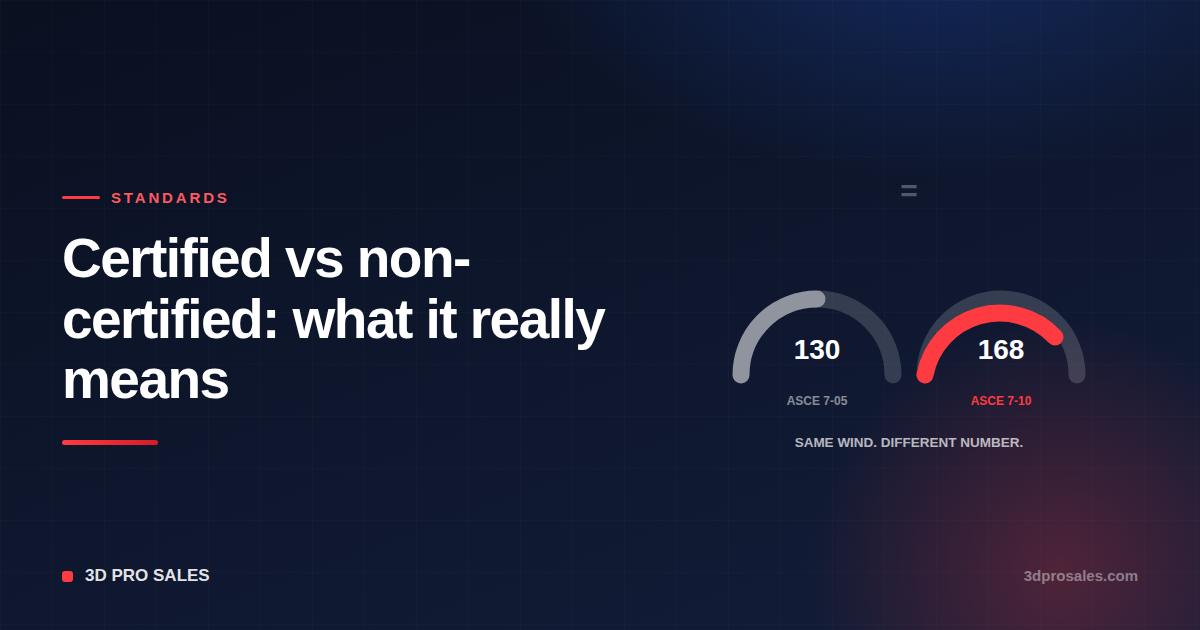
Wind speeds have been quoted under two different standards. Older ratings use allowable stress design speeds from ASCE 7-05. Modern codes use ultimate design speeds from ASCE 7-10 and later. They describe the same wind with very different numbers.
The Texas Department of Insurance publishes the conversion for its own coastal zones:
| TDI zone | Old rating (ASCE 7-05) | Same wind, ultimate (ASCE 7-10) |
|---|---|---|
| Inland II | 110 mph | 143 mph |
| Inland I | 120 mph | 155 mph |
| Seaward | 130 mph | 168 mph |
Read that table again. A carport advertised as "130 mph rated" and a code map showing "168 mph" can be describing the same structural demand. A dealer who does not know this will either undersell a perfectly adequate building or, far worse, sell a genuinely underrated one into a zone it cannot handle.
When a customer quotes you a wind number, the only useful follow-up question is: under which standard?
Anchoring is where the rating becomes real
A wind rating is a claim about a complete load path. In high-wind zones the governing demand is usually uplift, and uplift is resisted at the anchors. Anchor type, count, spacing, and embedment come off the engineered drawings for that site, not off a generic chart.
Substrate changes the hardware. Concrete typically takes wedge or expansion anchors. Asphalt takes barbed drive anchors, because asphalt is soft and prone to cracking around expansion hardware. Bare ground takes helical auger anchors, the same family used on mobile homes. Those are the industry typicals published by manufacturers, and they are worth knowing, but the specification that governs your install is the one on your sealed drawing.
Worth noting for Florida: anchors are explicitly named as a "structural component" subcategory in Florida's product approval rule (Rule 61G20-3.002), so a plan reviewer there may ask for approval documentation on the anchors themselves.
What to actually ask a manufacturer
- Is this rating stated in ASCE 7-05 allowable stress, or ASCE 7-10 or later ultimate?
- What exposure category was assumed? In Florida's HVHZ, Exposure C is the mandatory default unless D applies, and that assumption moves the price.
- Does the sealed drawing cover my county, or a generic condition?
- What is the anchor schedule for my substrate, and does it come with the sealed set?
- If my inspector rejects it, who revises the engineering, and at whose cost?
Why this matters for how you sell
Most quote disputes in this industry are not really about price. They are about a customer discovering, after the sale, that the number they were given did not include the certification, the anchors, or the engineering their county requires. That is a trust problem, and trust problems cost more than steel.
The fix is structural, not verbal. If your quoting tool asks for the install location up front and adjusts certification options and pricing accordingly, the conversation never happens. If it does not, your team re-quotes on every follow-up call.
See your buildings and your prices in 3D
3D Pro Sales turns your price book into a branded 3D builder backed by a full CRM. Founder pricing for early partners.
Book a Demo →