Florida Metal Building Codes: HVHZ, Wind Speeds and Permits
Florida is the opposite of Texas. Where Texas has no uniform code and wildly variable enforcement, Florida has a single statewide building code and takes it seriously. That makes Florida easier to learn and less forgiving to get wrong.
One code, statewide
Florida operates under a single Florida Building Code administered by the Florida Building Commission. The current edition is the 8th Edition (2023), effective December 31, 2023, and it uses ASCE 7-22 for wind loads.
The HVHZ is only two counties
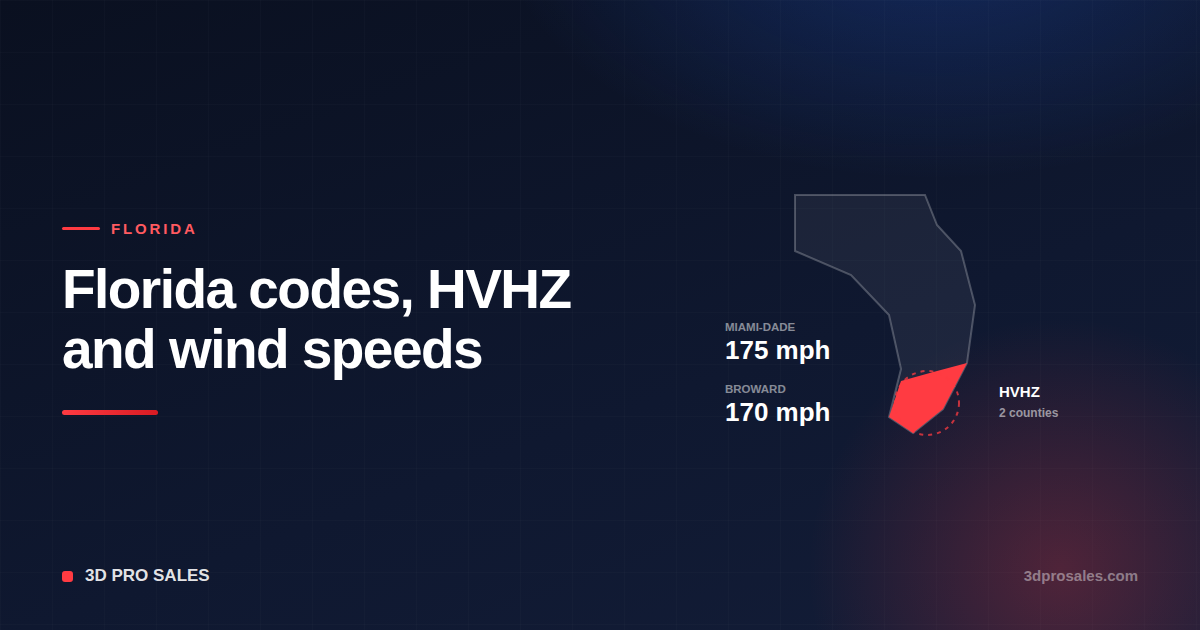
The High Velocity Hurricane Zone covers Miami-Dade and Broward counties. That is the entire list. It is not "South Florida" and it is not the whole coast, and dealers lose credibility by being vague about it.
Inside the HVHZ the design basis is materially different. Here are the 8th Edition ultimate design wind speeds, 3-second gust:
| County | Risk Cat I | Risk Cat II | Risk Cat III | Risk Cat IV |
|---|---|---|---|---|
| Miami-Dade | 165 mph | 175 mph | 186 mph | 195 mph |
| Broward | 156 mph | 170 mph | 180 mph | 185 mph |
A typical carport or metal building is Risk Category II, so 175 mph in Miami-Dade and 170 mph in Broward are the numbers that matter for most dealers.
There is a second cost driver inside the HVHZ that is easy to miss. Structures are to be considered Exposure Category C unless Exposure D applies. That default assumption is not something you get to argue down, and it moves the engineering.
Product approval and the Miami-Dade NOA
Florida requires Commission approval for certain product categories, including "structural components." The rule defines those to include anchors, structural wall components and roof deck, which is to say, most of a metal carport.
Miami-Dade County's Product Control Division is a statutorily recognized evaluation entity, and its approval document is the Notice of Acceptance (NOA).
Now the nuance that vendor blogs skip. Florida statute contains a carve-out: products "which are custom fabricated or assembled shall not require separate approval under this section provided the component parts have been approved for the fabricated or assembled product's use." That is very likely why many field-assembled carports are permitted on site-specific sealed engineering rather than on a whole-structure NOA.
So the accurate statement is not "metal carports require an NOA." Neither the statute, the rule, nor the code names carports as a product category. Components can fall under structural components, the AHJ may request approval documentation, and site-specific engineering is a common alternative path. Ask the building department which they want before you promise either.
Permits and the exemptions that are not what they look like
The Florida Building Code requires a permit for construction, enlargement, alteration, repair, moving or demolition. Statute lists exemptions, including storage sheds not exceeding 720 square feet that are not designed for human habitation, and nonresidential farm buildings on farms.
Read that carefully before repeating it to a customer. Exemption from the Code is not exemption from local zoning, setbacks, or permit requirements, and the farm building exemption is condition-bound.
Local practice varies even under a uniform technical code. Orange County requires a full building permit for residential accessory structures, including carports, exceeding 120 square feet, with plans signed and sealed by a Florida-licensed engineer or registered architect, a site plan, a grading and drainage plan, and a completed Product Approval Specification Sheet. Approved installation details must be on site at inspection or the inspection fails.
Miami-Dade's permit exemption list does not include carports, which means they are not exempt there.
One more thing about HB 803
A 2026 Florida law created a residential permit exemption for certain single-family work valued under $7,500, effective July 1, 2026. It is being widely misread.
It does not apply to structural modifications, and it does not apply in flood hazard areas or to commercial, condo or multifamily property. Erecting a new carport is structural work. Do not let a customer talk themselves into skipping a permit on the strength of a headline.
Selling into Florida well
Florida rewards precision. The state gives you a single technical rulebook, published wind speeds you can look up by county and risk category, and a product approval system with a searchable public library. A dealer who can tell a Broward customer their design speed is 170 mph and explain why Exposure C is assumed sounds like a professional. A dealer who says "it will be certified" sounds like everyone else.
See your buildings and your prices in 3D
3D Pro Sales turns your price book into a branded 3D builder backed by a full CRM. Founder pricing for early partners.
Book a Demo →